

Laser Power Transfer: From Fiber Isolation to Remote Energy Delivery
Power delivery can become a bottleneck when equipment operates at high electrical potential, in strong electromagnetic fields or where copper wiring is difficult. Laser power transfer converts electricity into light and recovers electrical power at the receiver. Its practical value often starts with isolation, installation and maintenance—not distance alone.
From source to load: two transmission routes
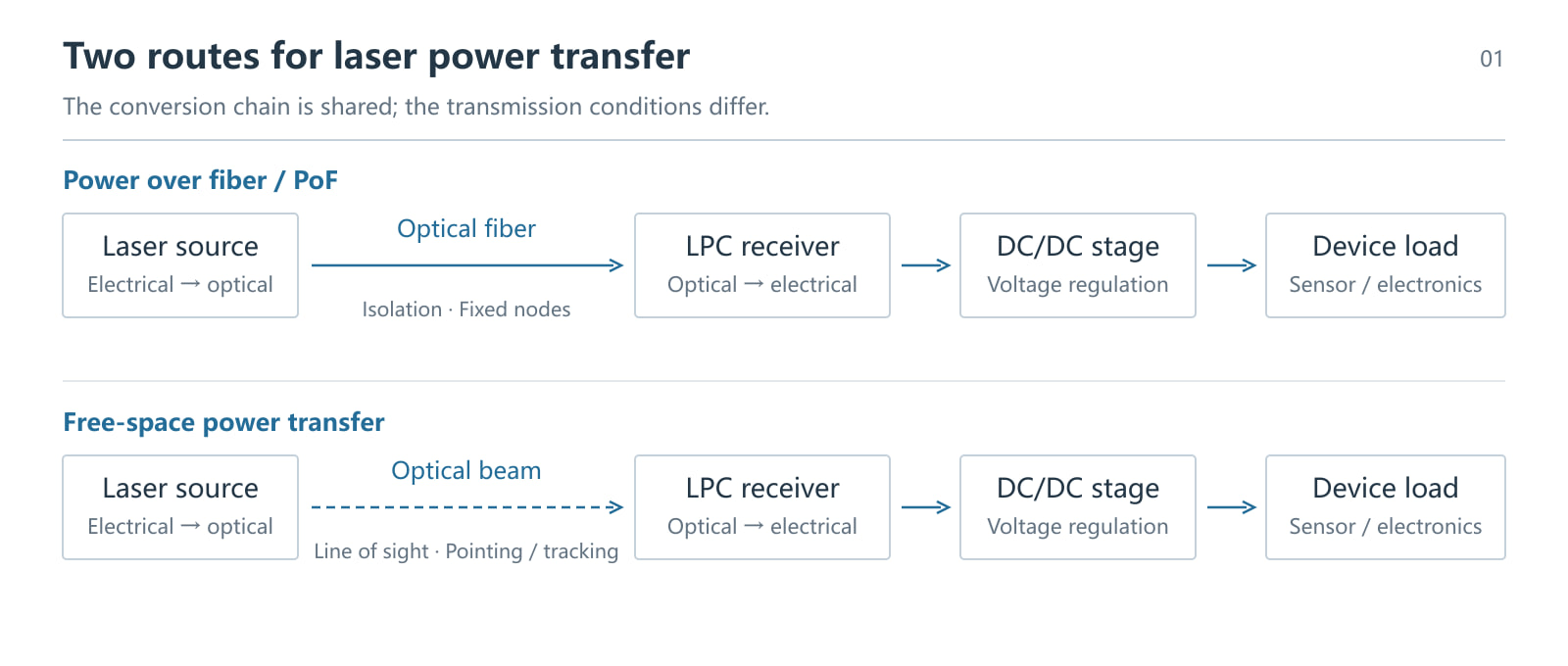
A typical chain combines a laser source, a transmission path, a laser power converter (LPC) and power-conditioning electronics. The receiver uses photovoltaic devices matched to the laser wavelength. Power over fiber (PoF) guides energy through an optical fiber and suits fixed nodes requiring galvanic isolation. Free-space beaming sends energy through an optical beam and depends more heavily on line of sight, pointing and tracking.
Research milestones need context
In 2021, Fraunhofer ISE reported 68.9% photovoltaic conversion efficiency under 858 nm laser illumination. This was a receiver-cell result under specified conditions, not wall-plug-to-load efficiency. A DARPA demonstration announced in 2025 delivered more than 800 W across 8.6 km for 30 seconds. That demonstrates potential, rather than proving continuous, all-weather service.
Where does optical power add value?
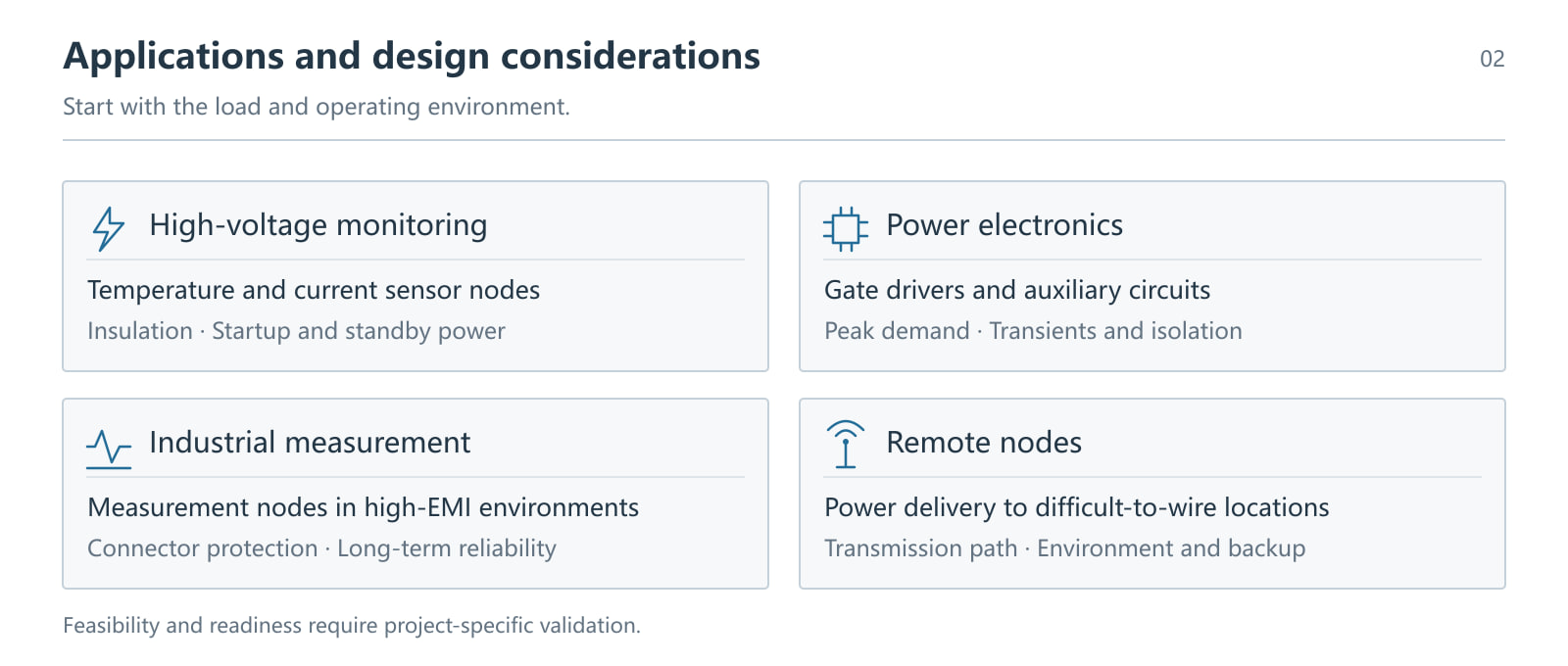
High-voltage monitoring needs isolated power for temperature and current sensor nodes. Optically powered gate-driver research also suggests opportunities for auxiliary circuits in power-electronic systems, including solid-state transformers; this does not replace their main power path. Industrial measurement benefits from electrical isolation in high-EMI environments. Remote nodes and unmanned platforms offer further possibilities, but environmental robustness and backup energy remain project-specific challenges.
Engineering starts with the load
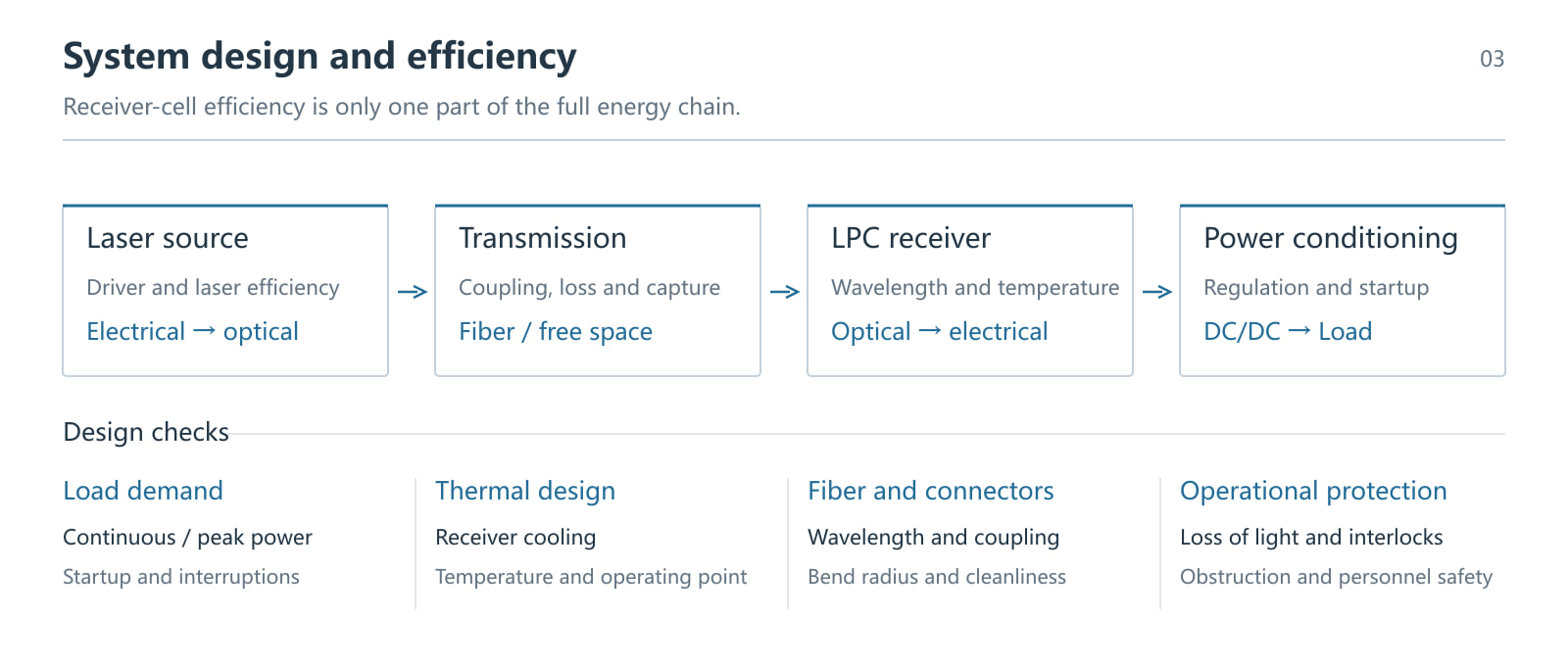
Define voltage, continuous and peak demand, startup time and allowable interruptions before choosing the laser. Account for coupling, transmission, photovoltaic conversion and DC/DC losses. Receiver cooling, clean fiber connectors and fault interlocks matter as much as nominal power. Free-space systems must also address weather, obstruction and eye safety. JAXA highlights the importance of precise pointing and safety in its laser-power research.
Match the chain, not just the power rating
Laser wavelength, fiber interface, LPC operating point, regulation and thermal design must work together. For MiracleTech laser devices, optical power converters and laser photovoltaic modules, the useful starting point is a defined load and operating environment, followed by datasheet-based verification. Laser power is a response to specific system constraints; reliability and maintenance cost determine its practical value.