

Laser Power Transmission System
MiracleTech provides laser power transmission solutions for remote power delivery, electrical isolation, and contactless power transfer, covering laser generation, optical transmission, photovoltaic conversion, and power management.
Our product portfolio includes semiconductor lasers with optical output powers ranging from a few watts to several kilowatts, laser power converters with electrical outputs from milliwatts to kilowatts, laser drivers, maximum power point tracking (MPPT) modules, and DC-DC power modules. We support component supply, module integration, and application-specific customization.
1. Solution Overview
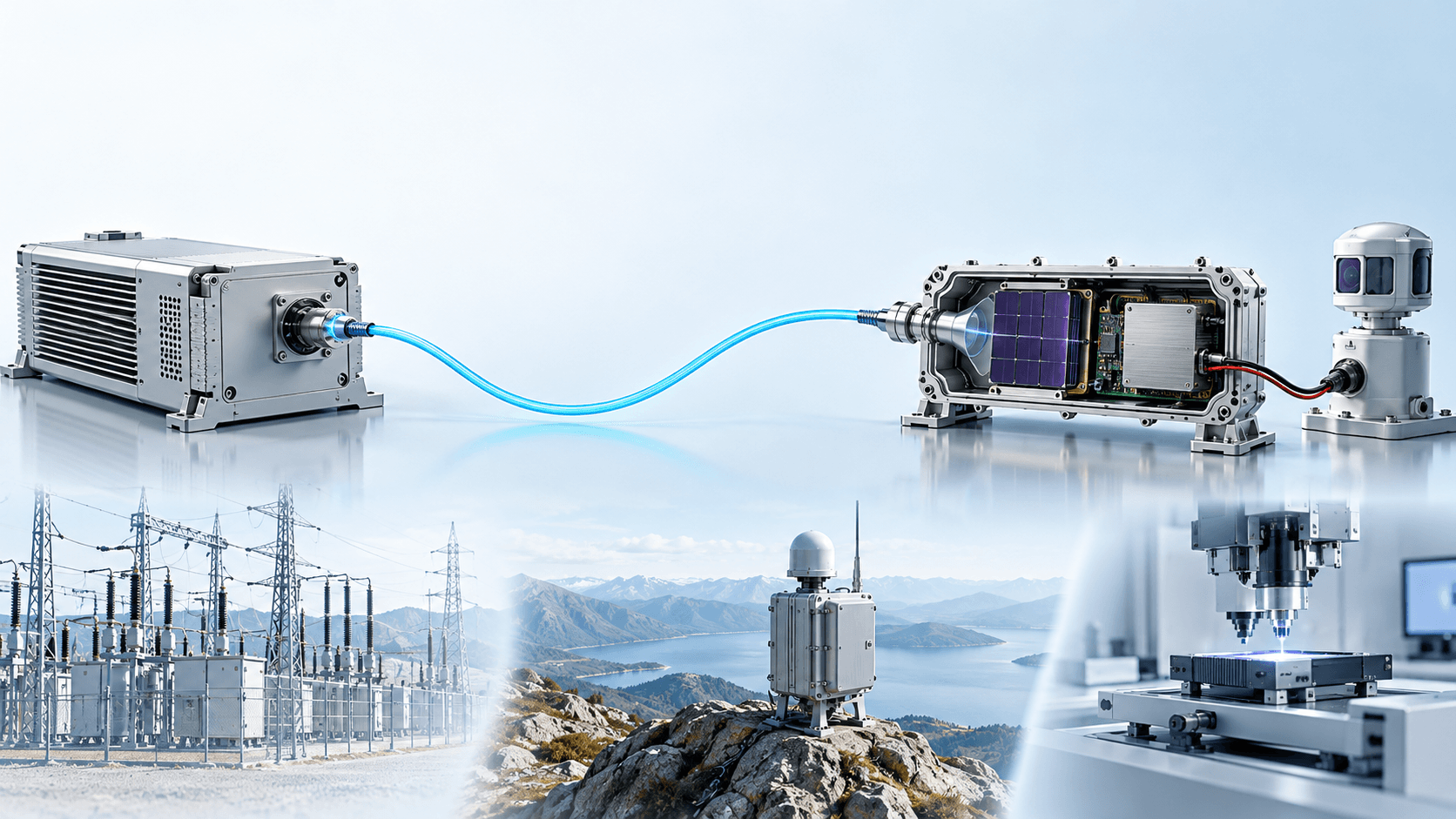
Laser power transmission uses laser light to deliver energy from a transmitter to a receiver. At the transmitting end, a laser converts electrical energy into optical energy. The light travels through an optical fiber or free space and is converted back into electricity by a laser power converter at the receiving end.
MPPT and power management modules then condition the electrical output to supply electronic equipment, sensor nodes, or energy storage devices.
Depending on the application, the system can use fiber-based or free-space transmission. Each solution is designed around the required output power, transmission distance, installation space, electrical isolation, and thermal conditions.
How laser light powers remote equipment
From electrical input at the transmitter to usable DC power at a remote load, the driver, optical link, photovoltaic receiver, and power management stages work together as one system.
Optical fiber / free-space link
Laser driver
Control · Protection
The driver supplies a controlled electrical input matched to the laser's operating current, voltage, startup sequence, and protection requirements. Driver ratings and usable load power must be evaluated separately.
Semiconductor laser
Electrical → Optical
The laser converts electrical energy into light at the selected wavelength. Coupling optics deliver the light into a fiber or a free-space beam. The transmitter and optical link are selected together with receiver response, coupling losses, distance, and alignment requirements.
LPC receiver
Optical → Electrical
The laser power converter turns light reaching its active area into electrical power. Output depends on incident optical power, illumination uniformity, active area, voltage, and temperature. Transmitted optical power is not the same as receiver electrical output.
MPPT / DC-DC
Tracking · Regulation
MPPT adjusts the receiver's operating point, while DC-DC conversion matches the output voltage to the load. Energy storage can buffer changing demand. Usable output must account for conversion losses and the required monitoring, enable control, and protection functions.
Remote load
Sense · Measure · Control
Conditioned power supplies remote electronics or an energy storage unit. Continuous consumption, peak current, and cooling conditions are assessed together, then temperature rise, dynamic response, and fault interlocks are verified at system level.
Monitoring and interlocks: temperature sensing, received-power feedback, enable control, and fault shutdown are configured for the application.
Illustration of the operating principle. Output capability, transmission distance, and overall efficiency depend on operating conditions and system-level testing.
2. System Components
Semiconductor Lasers and Laser Drivers
The semiconductor laser and its driver are selected to match the receiver’s spectral response, required optical power, and transmission method.
MiracleTech offers semiconductor lasers with optical output powers ranging from a few watts to several kilowatts. Depending on project requirements, the driver can incorporate current adjustment, soft start, enable control, and temperature protection, supporting adjustable optical output and coordinated system operation.
Optical Transmission and Coupling
The optical transmission system delivers laser light to the receiver and matches the illumination pattern to its active area.
Fiber-based systems require coordinated selection of optical coupling, fiber specifications, connectors, and transmission-loss allowances. Free-space systems require consideration of beam divergence, transmission distance, receiver aperture, alignment accuracy, and environmental conditions.
Appropriate optical design helps reduce light falling outside the active area, limit localized heating, and improve utilization of the receiver.
Laser Power Converters
A laser power converter, also known as a laser photovoltaic converter, is the core component that converts incoming laser light into electricity.
MiracleTech offers devices and modules with electrical output powers spanning the milliwatt to kilowatt range. Cell selection, series and parallel configurations, packaging, and thermal design can be tailored to the laser wavelength, incident optical power, active area, and required output voltage.
Different power levels serve applications ranging from low-power sensing and electronic equipment to high-power optical energy receivers.
MPPT and Power Management
The maximum power point of a laser power converter changes with incident optical power and operating temperature. An MPPT module adjusts the converter’s operating voltage or current to track this point and maximize the electrical power available under the prevailing conditions.
Combined with a DC-DC power stage, the system can adapt the output voltage to the load and incorporate application-specific functions such as:
Regulated DC output;
Energy storage buffering and battery charging;
Reverse-current blocking and output protection;
Voltage, current, and temperature monitoring;
Enable control and fault interlocks.
MPPT can be integrated into the DC-DC control system. The final configuration is selected according to the load and operating requirements.
3. Transmission Options
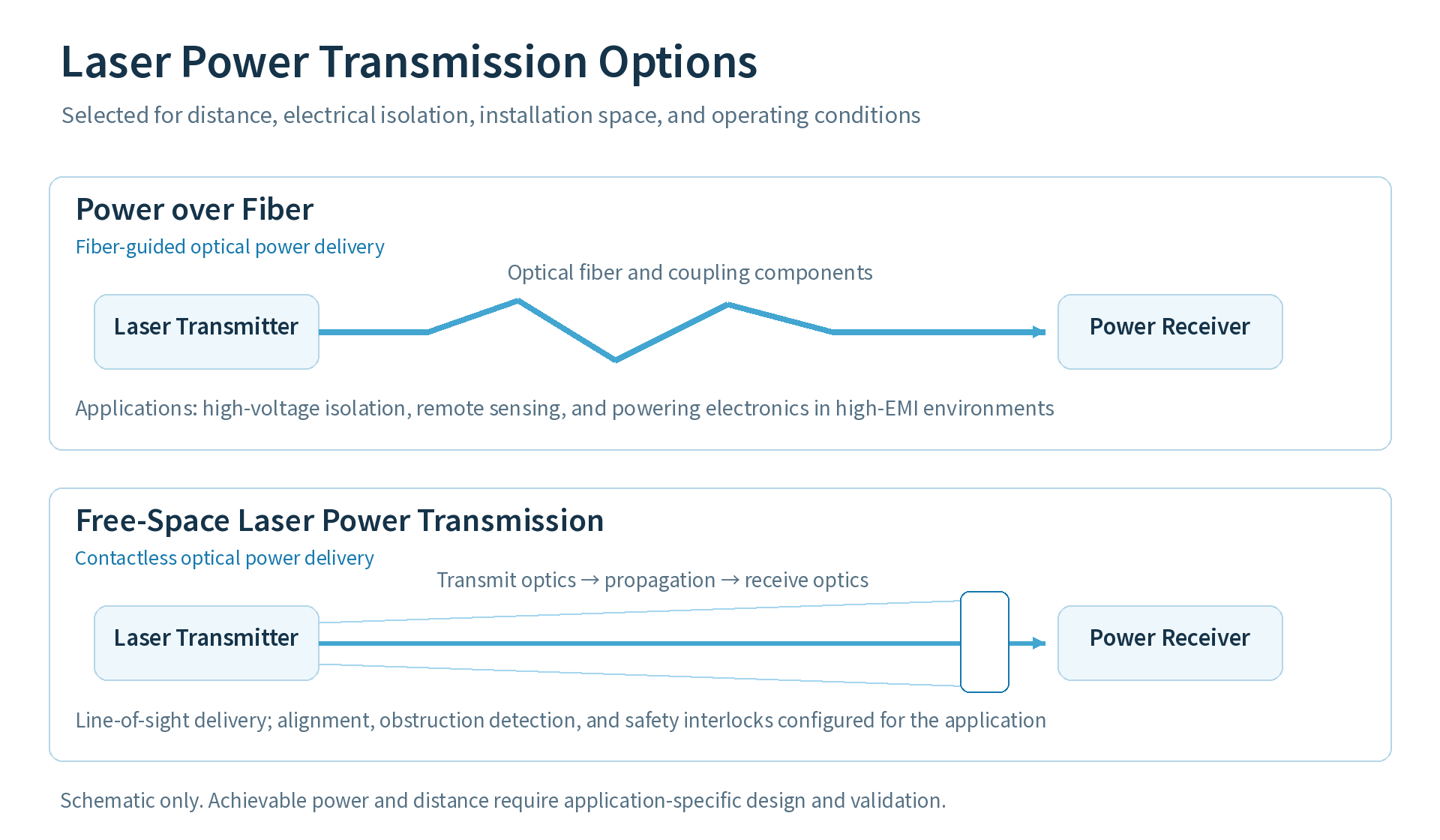
Power over Fiber
Power over Fiber delivers laser light to the receiver through an optical fiber and associated coupling components. It is suitable for applications requiring power delivery across different electrical potentials, remote powering, or routing through constrained spaces.
A suitably designed nonmetallic fiber link can provide an optical power path without an electrically conductive power connection. Overall insulation performance depends on the fiber, connectors, mechanical structure, and installation conditions.
Free-Space Laser Power Transmission
Free-space laser power transmission uses transmitting and receiving optics to deliver energy without a physical power connection, where a clear optical path is available.
The system is designed around transmission distance, beam size, receiver area, and environmental conditions. Alignment, obstruction detection, and safety interlocks can be incorporated according to the application.
4. Typical Applications
High-Voltage Isolation and Power Electronics
Optical power delivery can supply sensing, measurement, and control electronics operating at elevated electrical potentials, reducing the need for conductive power connections across isolation boundaries.
Remote Sensing and Industrial Monitoring
For sensor nodes where wiring is difficult, maintenance access is limited, or electromagnetic interference is significant, optical power delivery can be combined with energy storage to support continuous or intermittent operation.
The optical power link also avoids introducing an electrical ground loop through the power supply cable.
Sealed Equipment and Contactless Power Delivery
Where suitable optical windows and transmission conditions are available, laser power transmission can deliver energy to electronics inside sealed enclosures. Window materials, receiver structures, and protective features are selected for the operating environment.
Research and Prototype Development
MiracleTech supplies lasers, drivers, optical power receivers, and power management modules for research into laser power transmission, photovoltaic conversion, MPPT control, and thermal management, supporting development from component evaluation to system prototypes.
5. Customization and Integration
Requirements Definition
We begin by defining the required electrical output power and voltage, continuous or pulsed operation, transmission path and distance, insulation requirements, available space, and operating environment.
Component and System Matching
Laser wavelength, transmitted optical power, transmission components, receiver area, and thermal conditions are evaluated together. MPPT, DC-DC conversion, and energy storage are then configured to match the application.
Prototype Validation
Output power, temperature rise, dynamic response, and protection functions are verified under representative illumination and cooling conditions. Mechanical, electrical, and control interfaces are then integrated into the system.
6. System Selection Considerations
Laser optical output power, receiver electrical output power, and usable load power are different specifications and must be evaluated separately.
Receiver output depends on the optical power reaching the active area, illumination matching, photovoltaic conversion efficiency, and operating temperature. Usable load power must also account for power management losses.
High-power systems require particular attention to illumination uniformity, power distribution, electrical interconnections, and heat removal. Achievable output power, transmission distance, and overall efficiency are evaluated and validated for the specific application.
Compare the transmission paths
| Consideration | Power over fiber | Free-space link |
|---|---|---|
| Path | Fiber and coupling components | Clear optical path and alignment |
| Integration | Fiber routing and connectors | Transmit/receive optics and mounting |
| Validation | Coupling loss, temperature and receiver matching | Beam footprint, obstruction and receiver matching |
Laser optical output, receiver electrical output and usable load power are different quantities. Select against confirmed component specifications and verify the complete system under the intended conditions.
Contact Us
Share your target output voltage and power, transmission distance and path, installation dimensions, and operating environment.
MiracleTech can match laser transmitters, optical power receivers, and power management products to your application, providing core components and customized integration support.